Seminar for Arabian Studies
Abstracts - 2006 Seminar
The 2006 Seminar for Arabian Studies was held held from Thursday 27th to Saturday 29th July 2006, at the
British Museum
, London, U.K.
This event was supported by the
MBI Foundation
.
Visit their website at:
www.mbifoundation.com
and read details about their sponsorship at
http://www.mbifoundation.com/projects/seminar.html

All lectures were held in the Stevenson Auditorium in the
Clore Centre
within the British Museum.
Click here
to view the provisional timetable for the 2006 Seminar.
Please
(Microsoft Word format, 46 Kb)
for a booking form for the 2006 Seminar and Accommodation.
All the abstracts below are for papers which were orally presented at the Seminar, except where otherwise stated.
THURSDAY 27 JULY 2006
9:00 Registration
9:30 Welcoming remarks: John CURTIS, Keeper of the Department of the Ancient Near East, British Museum, UK.
SESSION I: Palaeolithic & early prehistoric Arabia (chair: Mike PETRAGLIA , Leverhulme Centre for Human Evolutionary Studies , University of Cambridge, UK)
9:40 Early prehistory in the Farasan Islands and the Southern Red Sea. Geoff BAILEY ( University of York , York, UK).
Biography:
Department of Archaeology, University of York. I taught at the Universities of Cambridge and Newcastle upon Tyne before taking up my present appointment at York in 2004. I ran the Klithi project on the Palaeolithic archaeology of NW Greece in the 1980s and current interests include the archaeology of shell middens, prehistoric coastlines and submerged landscapes.
Abstract:
The earliest human populations to move out of Africa to colonise Europe and Asia did so at about 1.8 million years ago. A later wave of dispersal associated with anatomically modern humans is believed to have taken place about 130,000 years ago. The Red Sea region and the Arabian Peninsula provide a key stepping-stone between Africa and the rest of the world, and a variety of archaeological, fossil and DNA indicators increasingly point to the southern dispersal route across the Bab el Mandeb and the southern Arabian Peninsula as a favoured pathway.
Oceanographic and climatological data show that throughout most of the period in question, sea level was 50 to 150m lower than the present. Extensive areas of the now-submerged continental shelf were available for human occupation, most probably with freshwater lakes and springs and more attractive conditions for human settlement than the more arid hinterland, especially at the southern end of the Red Sea in areas such as the Farasan Islands. The drop in sea level would also have created a sea channel between the African and Arabian coastlines much narrower than the present and no more difficult to cross than a large river.
Here we report on a new collaborative Saudi-UK initiative with an international team of specialists to conduct more detailed survey of the archaeology and geology of the Red Sea coastline of Saudi Arabia, and to undertake a combined land and underwater survey of the Farasan Islands. The underwater component of the survey will be looking for traces of the submerged landscape and associated archaeology at all depths on the continental shelf using a variety of techniques including coring, remote sensing, deep diving and photographic survey.
10:05 Among Arabian Sands: evidence for hunter-gatherer range expansions into Oman during the Pleistocene. Jeffrey I. ROSE ( Southern Methodist University , Dallas, USA).
Biography:
Jeffrey Rose recently completed his PhD at Southern Methodist University, investigating the role of the Arabian Peninsula in the origin of modern humans. He directs the Central Oman Pleistocene Research program (COPR), an ongoing project to articulate the variety of Palaeolithic industries and to build a chronological framework for the region.
Abstract:
Studies of mtDNA haplogroup M suggest the Eurasian lineage of modern humans branched from an ancestral African population between 70-40 kya. The primary route of migration out of Africa was across the Bab al-Mandeb Strait into southern Arabia.
Until now, Palaeolithic archaeology in South Arabia has been terra incognita, therefore the genetic evidence is unverifiable. Fieldwork conducted by the Central Oman Pleistocene Research program between 2002 and 2006 has produced a number of potential Pleistocene lithic assemblages with techno-typological affinities to industries in the Horn of Africa, the Levant, and India, underscoring Arabia's role as a nexus between three continents. These new data from Oman suggest that there were a series of hunter-gatherer range expansions into Arabia from all three contiguous refugia. One or more of these expansions may correlate with the predicted divergence of haplogroup M, although raises further questions regarding the geographic origin of the emigrating population.
10:30 Spreading the Neolithic over the Arabian Peninsula. Philipp DRECHSLER ( Tübingen University , Germany).
Biography:
Philipp Drechsler is a third year Ph.D. student at the University of Tuebingen, Germany. The focus of his dissertation is the spread of the Neolithic over the Arabian Peninsula with a general interest in human-environment interrelations. He specialises in GIS applications in archaeology.
Abstract:
The process of Neolithisation of the Arabian Peninsula is only poorly understood. The presence of domesticated sheep, goat and cattle in archaeological sites points to a Levantine origin for the Neolithic. In contrast, the material culture from these same sites indicates local developments.
One possible way to approach a resolution for this dilemma is in the simulation of possible routes of spread using Geographical Information Systems. In my work I assume that environmental conditions form the stage on which Levantine PPNB herders could act to explore the landmass of Arabia.
I see the background for this spread in a phase of humid climatic conditions during the early Holocene. This humid phase was interrupted by a drying event lasting about 500 years between 6500 and 6000 cal B.C., which halted the spread of PPNB peoples and forced these herders and their herds to withdraw to environmentally favoured areas in the southern part of the Arabian Peninsula. In these regions they came into intensive contact with local population groups leading to acculturation processes. When more favourable climatic conditions returned circa 6000 cal B.C., a cultural complex referred to as the 'Arabian Bifacial Tradition', which included Levantine and Arabian elements, spread very quickly over most of the Arabian Peninsula. Therefore I propose that the Neolithisation of the Arabian Peninsula can be seen as a process in which foreign Levantine and local Arabian population groups both participated.
10:55-11:30 Coffee
11:30 Neolithic Tombs, Burnt Mounds and Flints in the Desert: Recent Work in the Umm az-Zamul Region of Abu Dhabi Emirate, UAE. Richard CUTTLER (University of Birmingham, U.K), Heiko KALLWEIT (Freiburg, Germany), Mark BEECH (ADACH, U.A.E), Anja Zander (ASA Laboratory for Archaeometry, Germany), Will Pitt (University of Birmingham, U.K.) & Walid Yasin AL-TIKRITI (ADACH, U.A.E.).
Biographies:
Cuttler, Richard
Birmingham Archaeology, University of Birmingham, Birmingham, U.K.
Richard Cuttler BA, PG, Dip Archaeol MIFA is Senior Project Manager for Birmingham Archaeology in the U.K. He is responsible for project costings, designs, excavation projects, various types of fieldwork, post-excavation analysis and report preparation. He has supervised excavations at Little Paxton and Fengate in Cambridgeshire and in the Midlands and directed excavations in Anglesey on the DBFO, A55 road scheme. With over eleven years experience in field archaeology, Richard has a particular expertise in measured survey and associated software, including Arcview, Access and Autocad.
Kallweit, Heiko
Freiburg, Germany.
Dr Heiko Kallweit, PhD awarded at Freiburg University, 1996. His PhD thesis examined the 'Bronzezeitliche und Neolithische Besiedlung im Wadi Dhah, Republik Jemen'. He acts as a consultant on various international archaeology projects, and has worked regularly with the Abu Dhabi Islands Archaeological Survey (ADIAS) since 2001 on a number of archaeological and palaeontological projects. Dr Kallweit has published widely on the Neolithic period in the Arabian peninsula with a particular focus on the development of lithic technology.
Beech, Mark
Abu Dhabi Authority for Culture and Heritage (ADACH), Abu Dhabi, U.A.E.
Dr Mark Beech has a Masters degree in Environmental Archaeology and Palaeoeconomy from the Department of Archaeology, University of Sheffield, U.K. (1987) and a PhD from the Departments of Archaeology and Biology at the University of York, U.K. (2001). The title of his PhD thesis was 'In the Land of the Ichthyophagi: Modelling fish exploitation in the Arabian Gulf and Gulf of Oman from the 5th millennium BC to the Late Islamic Period'. He has been involved in the archaeology of the United Arab Emirates since 1994. From 2002-2006 Dr Beech was Senior Resident Archaeologist for the Abu Dhabi Islands Archaeological Survey (ADIAS). On the 1 June 2006 he joined the newly formed Abu Dhabi Authority for Culture and Heritage as Head of Division - Cultural Landscapes.
Anja Zander
ASA Laboratory for Archaeometry, Wadgassen, Germany
Anja Zander is a specialist in Optical Stimulated Luminescence (OSL) dating. She is formerly a member of the Faculty of Geography at Marburg University in Germany, and now works at the ASA Laboratory for Archaeometry in Wadgassen, Germany.
Will Pitt
University of Birmingham, Birmingham, U.K.
Will Pitt is a Masters degree student at the Institute of Archaeology and Antiquity at the University of Birmingham. His Masters degree project modelled the lithics data from the Khor Al Manahil site using GIS techniques.
al-Tikriti, Walid Yasin
Abu Dhabi Authority for Culture and Heritage (ADACH), Al Ain, U.A.E.
Dr Walid Yasin al-Tikriti has a PhD from the University of Cambridge, U.K. (1983). His PhD thesis was entitled 'Reconsideration of the Late Fourth and Third Millennium B.C. in the Arabian Gulf with Special Reference to the United Arab Emirates'. Since the early 1970's he has been involved in the archaeology of the United Arab Emirates. He worked as Archaeology Advisor at the Department of Antiquities and Tourism in Al Ain from the late 1970's until 2006. He has recently joined the newly formed Abu Dhabi Authority for Culture and Heritage as Head of Division - Archaeology.
Abstract:
The recent investigation of two sites located in the Umm az-Zamul region in the south eastern desert of Abu Dhabi emirate, UAE, provides important new information concerning the Neolithic period in south-eastern Arabia.
The fieldwork was again carried out in a joint project by the Abu Dhabi Islands Archaeological Survey (ADIAS) and the Department of Antiquities and Tourism in Abu Dhabi's Eastern Region, both now part of the Abu Dhabi Authority for Culture and Heritage.
The controlled pick-up of lithics and mapping was completed for the Khor al-Manahil area. New features identified included a series of enigmatic burnt mounds. An initial phase of analysis on the composition of the lithic assemblage has now been completed. Projectile points, other tools, cores and production waste (debitage) will be discussed.
Work also continued on the series of sites previously identified in the Kharimat Khor al-Manahil area. Excavations on the 'building structure' at site KHM0046 revealed a subterranean construction with a stone cist at the bottom. A detailed record of the spread of the collapsed stone slabs around the preserved super-structure displays an almost squared space. This is altogether an unusual result, representing a unique type of construction so far not recorded in the UAE. Two shell beads, found on the surface close to the structure resemble types well known from the Neolithic cemetery of Jebel al-Buhais 18, located in Sharjah emirate in the UAE.
11:55 Les niveaux VIe millenaire de Suwayh SWY-1, Sultanat of Oman. Vincent CHARPENTIER ( Maison de l'Archéologie & de l'Ethnologie, Nanterre cédex, France ).
Biography:
Prehistorian (UMR 7041 CNRS Nanterre), Vincent Charpentier has worked in France, the North American Arctic and Iraq. Since 1985 he has been involved in excavations of neolithic sites along the Omani coast (Ra's al Jins, Al-Haddah, Suwayh projects). His new project is Akab Island in Umm al-Qawain Emirate, UAE. He is also Partnerships & Media Relations Manager for the Institut National de Recherches Archéologiques Préventives (INRAP, Paris), as well as being a journalist and scientific broadcaster for France Culture (Radio France).
Related websites:
http://www.inrap.fr
http://web.mae.u-paris10.fr/arscan/harocdetail.php?ID=33286&query
Abstract:
Les niveaux recents et la necropole de Suwayh 1 avaient ete presentes dans le cadre d' un precedent Proceedings of the Seminar, nous presentons aujourd hui les horizons anciens de cet important site cotier, dates de 5500 BC cal, leurs structures d' habitat et culture materielle.
12:20 Kârimis: The Yemeni Evidence. Eric
(
University of Paris 1
, France).
Biography:
Vallet, Eric
Department of Historié, Université Paris I, Panthéon-Sorbonne, France
Eric is a PhD Candidate studying the topic of 'Power, trade and traders in Rasûlid Yemen (xiiith-xvth c.)' under the supervision of Prof. Françoise Micheau (Université Paris I Panthéon-Sorbonne). He is also a Teaching assistant at the Université Paris I Panthéon Sorbonne, UFR Histoire and associated with the UMR 8167 Orient et Méditerranée, Laboratoire Islam medieval, Paris (CNRS-Université Paris I & Paris IV).
Abstract:
From the 11th to 15th centuries, Kârimi merchants have been key actors in the long-distance trade between Egypt and the Indian Ocean. They have been since the first notice devoted to them by Quatremère in 1827 the subject of a rich literature. Nevertheless many questions related to the remain until now obscure. Who were they exactly? Did they form a firmly organized group, a 'cartel' as it was sometimes asserted? Was the Kârimi designation limited to an economic specialization (trade in spices), a specific level of wealth, often a great one, or a special origin? Some administrative documents from the Rasûlid sultanate (1229-1454) available nowadays, especially the Nûr al-ma'ârif collection, allow us to deal with these questions following a rather different perspective than the one offered by the mamlûk sources. Extending some hypotheses first expressed by S. D. Goitein, we shall try to investigate the strong relationships between the Kârimis merchants and the organization of navigation in the Red Sea. Then, we will describe, relying on the historical documentation available, some of the main transformations known by the Kârimis between the second part of the 13th century and the beginning of the 15th century.
Acteurs clés du commerce de longue distance entre l'Egypte et l'océan Indien du XIe au XVe siècle, les marchands Karimis ont suscité depuis la première notice que leur consacra Quatremère en 1827, une abondante littérature qui n'est pas parvenue à épuiser leur mystère. Qui étaient-ils exactement? Constituaient-ils un groupe solidement organisé, un "cartel" comme on l'a parfois affirmé? La qualité de Karimi était-elle liée aux produits qu'ils commerçaient (les épices), à leur richesse, quelquefois considérable, ou même à leur provenance géographique? Les documents administratifs émanant du sultanat rasûlide (1229-1454) et parvenus jusqu'à nous, notamment Nûr al-ma'ârif permettent d'aborder ces questions sous un autre angle que celui des sources syro-égyptiennes. En prolongeant des hypothèses formulées pour la première fois par S. D. Goitein, nous tenterons notamment d'examiner le rapport étroit qui unissait les marchands karimis et la navigation en mer Rouge. Puis, en nous appuyant sur la documentation historique disponible, nous retracerons certaines des principales transformations qui affectèrent ce groupe entre la seconde moitié du XIIIe siècle et le premier quart du XVe siècle, moment qui vit sinon sa disparition, du moins son brutal effacement.
12:45-14.00 Lunch
SESSION II: 3rd-1st Millennium BC Southeast Arabia (chair: Lloyd WEEKS University of Nottingham, UK)
14:00 Transformation processes in oasis settlements in Oman 2005 - final stage: Archaeological survey at the oasis of Nizwa. Juergen SCHREIBER (DAI, Germany).
Biography:
Jürgen Schreiber studied Near Eastern Archaeology at Munich University. Since 1995 he took part in several excavations in the Sultanate of Oman. In 2000 and 2001 he worked on the pottery of the 'Transformation processes in oasis settlements in Oman' project and became a scientific assistant to this project in the German Archaeological Institute in Berlin in 2002. Since 2004 he has been the field-director of this project.
Abstract:
In the context of the German-Omani co-operation project "Transformation processes in Oasis settlements in Oman" the last phase of archaeological investigations started in the spring of 2005.
After Izki and Jebel Akhdar in 2004, fieldwork concentrated on Nizwa, which always played an important part in the country's history as a political and religious centre.
Today, Nizwa oasis has a north-south extension of nearly 20 km and is with its 60,000 inhabitants the largest inland oasis of central Oman. As the process of urbanisation is in fast progress at Nizwa, large areas are already sealed by modern building activities and many archaeological sites were destroyed. Despite this situation we were able to record some 300 find-spots from the late 4th/early 3rd millennium BC to the late Islamic period. These sites with a major emphasis in the early Iron Age and the middle Islamic period, allow us to sketch the development of settlement activities within this oasis. The preliminary results will be presented in this paper.
14:25 Investigations at Wadi Bani Kharous, Sultanate of Oman. Moawiyah IBRAHIM ( Al-Isra' University , Jordan) & Badar AL-ALAWI ( Sultan Qaboos University , Oman).
Biographies:
Ibrahim, Moawiyah
Al-Isra' University, Jordan
Moawiyah M. Ibrahim is a professor and Head of the Center for Consultation, Continuing Education and Community Service at Al-Isra Private University, Jordan. He is a Ph.D graduate of the Free University of Berlin (1970). Since graduation he held several academic and administrative positions at Yarmouk University including Dean of Arts, Humanities and Social Sciences (1981-84), Founding Director of the Institute of Archaeology and Anthropology (1984-91). He was a professor and Founding Director of the Department of Archaeology at Sultan Qaboos University, Oman. He was guest professor at the University of Jordan, Free University of Berlin (1973-74), University of Tuebingen (1976) and was twice Fulbright Scholar: University of Pennsylvania (1985-86) and the University of Richmond, Virginia (1992-93). He carried out excavations and other research projects in Palestine, Jordan, Germany, Bahrain, Kuwait, Yemen and Oman. Prof. Ibrahim is the author/editor of several volumes and over 100 articles in specialized journals and books.
Al-Alawi, Badar
Sultan Qaboos University, Oman
From 1987 to 1991 I completed the degree of licentiate with specialization in History from the Faculty of Arts, Sultan Qaboos University, Oman. From 1991 to 1994 I worked as a Demonstrator (reader) in the Department of History, Faculty of Arts S.Q.U. From 1994 to 1997 I completed my Postgraduate Masters degree from the University of Yarmuk in Jordan, Institute of Anthropology and Archaeology, with a specialization in History and Archaeology. This has been published and is titled Qal'at Nizaw Dirasa Imariyya Muqarana 1650-1979 AD. I have also published a work entitled Yanqel 'Abr al-Tarikh.
From 1997 to 2000 I worked as Assistant Lecturer at S.Q.U in the History Department. From 2000 to 2003 I completed my Ph.D in History at the Department of Middle Eastern Studies in the Faculty of Arts at the University of Manchester. The title of the thesis was: Oman and the Islamic Caliphate 11-446/632- 1055 The Military Struggle. Since 2003 I have been working as Assistant Professor in the Department of History, Faculty of Arts and Social Sciences, Sultan Qaboos University, Oman. I am currently an Assistant Professor at S.Q.U. and teach courses including Oman and Islamic Civilization, Islamic History of Oman, The History of the Umayyad and Abbasid periods.
Abstract:
This project intends to address the occupational history of Wadi Bani Kharous, a side wadi which intersects the western Jabal al-Akhdar, based on historical records, oral history and archaeological data. Preliminary field investigations in this wadi were conducted between December 2002 and February 2003 and resumed in 2004. Special emphasis is upon over seventy tombs inscriptions from two cemeteries and several panels of rock inscriptions and drawings which were recently recorded. The inscriptions can be seen as a continuation of epigraphical work published by the first author (PSAS 2001) from Nizwa and Wadi el-Haymali. They date since the 9th century until the fourteenth century A.H. and reflect the ethnic, tribal and family association of the community in this area. Some inscriptions provide information about the social status of both males and females. It is worth mentioning that this is one of the best known wadis in Oman. Several rulers (including three of the early Imams), theologians, scholars and poets originate from Wadi Bani Kharous. The investigations will be complemented by oral history of descendants still living in the area. Preliminary fieldwork shows that the occupational history here goes back as early as the third/second millennium B.C. A major Iron Age fortification system was attested on the rocky hills surrounding Sital village. A reference will be also made to the agricultural and water systems as well as to the settlement patterns along both sides of the wadi.
14:50 Riding the Crest: lessons from the loss of the Magan Boat. Tom VOSMER (Magan Boat Project).
Biography:
Not yet provided.
Abstract:
On September 7, 2005, the Magan Boat, a 12-metre hypothetical reconstruction of a Bronze Age Indian Ocean vessel, departed Sur, Oman on its passage to Bet Dwarka and Mandvi in Gujarat, India.
After a day of light and variable winds, a moderate south-westerly set in and the boat cleared Ras al Hadd on the eastern tip of Arabia, headed for India. Seas were moderate, and though rolling heavily in the ocean swell, the boat was sailing very well in a wind of about 15 knots.
During the night the crew noticed water in the bilge, and set to bailing the vessel. Although the crew were not unduly alarmed at first, it quickly became clear that the situation was very serious. Despite the crew's best efforts, within 45 minutes the vessel had been swamped and the crew were forced to abandon ship.
The lessons gained from the construction process and the unfortunate and regrettable loss of the boat have been plentiful and instructive. All hold implications for our understanding of Bronze Age boat-building, trade, and navigation. This paper traces the construction of the vessel, and the discoveries revealed. The paper describes the events leading to the loss, the event itself, speculates on the primary probable causes and their solutions, and charts the future of the project aimed at the construction and sailing of another vessel.
15:15-15:45 Tea
SESSION III: Death and Burial Practice (chair: StJohn SIMPSON, The British Museum, UK)
15:45 A Tale of Two Tombs: an anthropological and artefactual evaluation of the collective Umm an-Nar graves, Hili N and Tomb A Hili North, An Ain, Emirate of Abu Dhabi, United Arab Emirates. Kathleen MCSWEENEY (University of Edinburgh, UK) & Sophie MÉRY (Maison de l'Archéologie et de l'Ethnologie, France).
Biographies:
McSweeney, Kathleen
School of Arts Culture and Environment, University of Edinburgh, Scotland
Kath McSweeney teaches osteoarchaeology at the University of Edinburgh. Her doctoral research included the analysis of the human remains from Tomb N at Hili in the UAE and she currently has responsibility for the anthropology in the ongoing joint French-Emirates programme of re-excavations at Hili.
Méry, Sophie
CNRS MSH-Nanterre, Maison de l'Archéologie et de l'Ethnologie, France
Sophie Méry is an archaeologist with the CNRS (MSH-Nanterre, France). Her PhD was on pottery production in the UAE and Oman and was published in 2000. She is the Director of the French Archaeological Mission in the UAE, and conducts the programme of excavations at Hili together with Dr Walid Yasin al-Tikriti.
Abstract:
The Hili archaeological complex in Al Ain, UAE, is important for its wealth of third millennium BC Umm an-Nar burial and settlement sites. Two of the most significant burial sites are Tomb A Hili North, excavated by the French Mission in the 1980s, and Hili N, originally excavated by the Department of Antiquities and Tourism, Al Ain, also in the 1980s, and currently the subject of re-excavation as part of the on-going joint project between the Department of Antiquities in Al Ain and the French Mission in the UAE.
Tomb A Hili North is a classic circular Umm an-Nar monumental grave, while Hili N is a pit-grave, one of only two Umm an-Nar period pit-graves discovered so far in the UAE. Both of these tombs contained the remains of hundreds of individuals, in the case of Tomb A Hili North, more than 300, while around 600 people had been deposited in Hili N. Both population groups have been the subject of anthropological and artefactual analyses and a comparison of the findings may help to shed light on the homogeneity of the people of the Umm an-Nar period.
A study comparing the skeletal populations is currently underway. Prior research suggested that there were similarities in mortality profiles and population health, but there may also have been some disparities, notably a reported difference in average stature. In this paper, the initial findings from the anthropological comparisons and of a parallel evaluation of the artefactual assemblages from the two sites will be presented.
16:10 Tribal links between the Gulf and the Middle Euphrates during the beginning of the second millennium B.C. Christine KEPINSKI (Archéologies et Sciences de l'Antiquité, CNRS, Nanterre Cedex, France).
Biography:
Member of the C.N.R.S. (National Centre for Scientific Research) since 1984, Dr. Christine Kepinski is an archaeologist who has headed several excavations in Iraq (Khirbet ed Diniye/Haradum, Tell Khoshi and Grai Resh) and in Turkey (Tilbeshar). She is mostly concerned with Mesopotamia from the IVth till the IInd mill. B.C.
Abstract:
Funerary practices are good indicators of identity. In the frame of salvage excavations conducted in Iraq during the years 1980, two main isolated graveyards were brought to light at Usiyeh and Shuweimiyeh. Together with Baghouz, they revealed the importance of nomad groups of the Middle Euphrates during the very beginning of the second millennium. Among the different types of graves, several were surrounded by a circular wall and covered with a gravel mound. They correspond exactly to those of Bahrein and others discovered for example in Jordan. They lasted during about two centuries and emphasize an identity that overlap the barriers of territorial states. Traces of contacts remain through some ritual ceramics which correspond, with a loss of technical ability, to some adaptations of stone vessels from the Gulf.
16:35 The Materials Employed in Ancient Yemeni Burial Practices.
Stephen BUCKLEY
,
Joann FLETCHER
,
Don BROTHWELL
(University of York, UK), Khaled AL-THOUR & Mohammed BASALAMA (
University of Sana'a
, Yemen).
Biographies:
Buckley, Stephen
Department of Archaeology, University of York, York, UK
Dr. Stephen Buckley is a Wellcome Research Fellow in Bioarchaeology at the University of York. As part of the university's Mummy Research Group he has studied human remains from Egypt, Nubia, Italy, Ireland, South and Central America and is currently undertaking long-term research into the mummification practices of ancient Yemen.
Fletcher, Joann
Department of Archaeology, University of York, York, UK
Dr. Joann Fletcher is an Honorary Research Fellow at the University of York. As part of the university's Mummy Research Group she has studied human remains from Egypt, Italy, the Canary Islands, Ireland and South America and is undertaking long-term research into the burial practices of ancient Yemen.
Al-Thour, Khaled
University of Sana'a, Yemen
Professor Khaled Al-Thour is a Professor in the Department of Geology at the University of Sana'a. As co-ordinator for the York University Mummy Research Team since 2002, he is involved with the geological analysis of the various burial environments.
Basalama, Mohammed
University of Sana'a, Yemen
Dr. Mohammed Basalama is a lecturer in the Department of Archaeology at the University of Sana'a. As an authority on ancient Yemeni burial practices, he has been closely involved in the work of the York University Mummy Research Team since 2002.
Brothwell, Don
Department of Archaeology, University of York, York, UK
Professor Don Brothwell is Professor Emeritus at the University of York and part of the university's Mummy Research Group. His long-term research into the mummification practices of ancient Yemen has included examination of the bodies by CT-scanning and the geological and chemical analysis of the various burial environments.
Abstract:
With very little known about the mummies of Yemen, even their very existence is ignored by recent publications which state that the ancient Egyptians are believed to be the only Old World people who practised mummification (1). Although this assumption clearly ignores recent descriptions (2), the mummies themselves are nevertheless dismissed as 'rudimentary', despite references to canopic equipment suggestive of evisceration. Using the analytical techniques of GC-MS which have already produced wide-ranging evidence for Egyptian mummification practices (3,4), Yemeni mummies dating from c. 1200 BC to 300 BC in the University of Sana'a are now the basis for similar scientific analysis at the University of York. Since mummification in antiquity was a complex process, combining the practical considerations of body preservation with ritualistic and symbolic concerns, this study has begun to provide valuable insights into aspects of ancient South Arabian culture. With artificial mummification clearly evident, preliminary findings have revealed the types of materials and methods employed, together with clear evidence of ritual practice.
(1) Parker Pearson et al., Antiquity 79 (2005): 529-546.
(2) Vogt in Queen of Sheba: Treasures from Ancient Yemen, ed. Simpson: 181-183.
(3) Buckley et al., The Analyst 124 (1999):443-452.
(4) Buckley & Evershed, Nature 413 (2001):837-841.
17:00 The Jewish cemetery at Sohar, Oman - revisited. Aviva KLEIN-FRANKE (Universität zu Köln, Germany).
Biography:
The area of research and teaching of the historian and anthropologist Aviva Klein-Franke is the Middle East, history and culture of its minorities and ethnic groups in general. For many years Aviva Klein-Franke has worked and published (in Hebrew, English and German) about the history and culture of the Jews in Islamic countries and especially of the Jewish community in Yemen. She has documented ancient and modern history, culture and material culture of the Jews of Yemen, their crafts, such as silversmith works, embroidery, weaving and pottery through the ages, worked about the collecting of the dijzya during the reign of Imam Yahya, about the Jews of Aden, on the ancient Hebrew tombstones in Aden and has also done documentary research on the Jewish cemetery of Aden. Currently she is doing research on the Jewish community of present day Yemen. Aviva Klein-Franke teaches at the Martin-Buber Institute for Jewish Studies at the University of Cologne, Germany.
Abstract:
I visited Oman twice to investigate the Jewish cemetery at Sohar. I took many photographs of the site and documented the names which are written on the bricks of the Memorial Wall.
Under the rule of the Persians the port of Sohar was built, Merchants from Persia founded colonies along the eastern shore of the Arabian Gulf. Sohar became a famous port. Trade Agencies from overseas settled at Sohar and traded with goods from China and Japan, Persia and Iraq, India and Yemen, Ethiopia and Egypt. Sohar became what the port of Aden had been, a place for exchanging goods. In the mercantile society of Sohar there also lived Jews originating from Persia and Irak. From the size of the Jewish cemetery at Sohar we can assume that in the past there was a big Jewish community at Sohar. The Jewish cemetery at Sohar was mentioned in a few works by scholars and travellers. Wellsted in 1835 found only 20 Jewish families living at Sohar, who had a synagogue and owned a few buildings. P. Costa mentioned Bayt Yahudi, which still stand as evidence of the past Jewish community of Sohar, but actually the important physical evidence is the Jewish cemetery of Sohar.
In 1958 Wendell Phillips and Alexander Honeyman measured the cemetery and investigated a few tombs out of two hundred. Paolo Costa illustrated the subject with many historical and ethnographic details. In 1980 he counted 95 graves in the cemetery. From year to year the number of graves decreased. In my visit at Sohar in the year 2005 I could count only 12 full tombs and another 5 half-open tombs. All over the ground there are bones scattered. The tombs have an unusual ellipse form, built of bricks and mortar in the form of steps of 5-7 rows; the higher the row, the shorter the ellipse.
In the front of the cemetery there is a massive memorial wall from Bricks. Many Hebrew names are engraved into the bricks on the four sides of the wall. Until today the names have not been documented. I copied most of them and took the measure of the wall.
I went through the Hebrew sources dealing with Arabia and commerce in the Middle
East in mediaeval times, I went through the 'Cairo Geniza' documents as well as Jewish and travellers´ sources and found some interesting related information about the Jews of Arabia as Traders.
17:25 END
18:30
Corridor of Commerce: Archaeology and the lives of the peoples of the Gulf over seven thousand years.
In this illustrated lecture, Dr Derek Kennet, archaeologist and lecturer at the University of Durham, will explore how the pivotal position of the Gulf from Antiquity to the 19th century is reflected in the rich archaeological heritage of this region.
Admission £5, Concessions £3,
Free to registered attendees of the Seminar
.
The lecture forms part of the British Museum's "
Middle East Now Season
".
FRIDAY 28 JULY 2006
SESSION IV: Early Historic Arabia (Chair: Jurgen SCHREIBER?, DAI, Germany)
9:30 The beads of ed-Dur (Umm al-Qaiwain, UAE). An DE WAELE (
Ghent University
, Belgium).
Biography:
An De Waele is a third year PhD student in Near Eastern Archaeology at Ghent University. Her dissertation focuses on the small finds of the site of ed-Dur (Umm al-Qaiwain, UAE).
In 2002, she received a MA in Archaeology at Ghent University analysing the wall paintings of the Parthians and Sasanians.
Abstract:
Ed-Dur is located in the Emirate of Umm al-Qaiwain (UAE) and is mainly dated to the late 1st c. B.C.-2nd c. AD. The great amount of imported material points towards intense contacts with other regions; ed-Dur must have played an important role in the Persian Gulf trade network and in the relations between the Roman world and India.
During the nine years of Belgian excavations, some 1200 beads made out of (semi-)precious stones, glass, frit, bronze, bone, shell, pearl etc. were unearthed. All the beads were geologically studied so that we know exactly which sorts of materials were used. The detailed study of these beads is very interesting since beads have far more prospects than we assume. Beads provide information on the mining and technical skills of populations and on their social and economic life. They even are important with the eye on the dating of contexts.
The paper discusses the beads from ed-Dur: the different sorts of materials used and their place of origin, manufacturing techniques, typology, chronology, context, function, distribution/trade patterns, diachronic evolution, symbolic meaning etc. This systematic analysis aims at giving more insight into the site of ed-Dur and its trade relations within the late pre-Islamic Arabian Peninsula and abroad.
9:55 Preliminary results of Compositional Analyses on SE-Arabian Coins from Ed-Dur (Umm Al-Qaiwain, UAE). Parsival DELRUE , David De MUYNCK, Pieter ROGIERS & An DE WAELE (Ghent University, Belgium).
Biographies:
Delrue, Parsival
Research Unit Near Eastern Archaeology, Ghent University, Belgium, in cooperation with the Department of Materials Science and Metallurgy, Ghent University, Belgium.
Parsival Delrue graduated with a MA in Archaeology at Ghent University (Belgium) in 1998 and in 2000 he received the degree of MA in Eastern Mediterranean Archaeology at Leuven University (Belgium). Currently he is preparing a PhD on the metal objects of ed-Dur (U.A.E., Umm al Qaiwain, UAE), titled 'Archaeometallurgical analyses of pre-Islamic artifacts from NE- & SE-Arabia, excavated by Ghent University', of which the defense is planned early 2007.
de Muynck, David
Laboratory of Analytical Chemistry, Ghent University, Belgium.
David De Muynck obtained a Master in Chemistry at Ghent University (Belgium) in 2004. The aim of his PhD research is the development of separation techniques to isolate different target elements from a wide range of materials (e.g. archaeological artifacts), preceding isotopic analysis by means of single collector and MC-ICP-MS.
Rogiers, Pieter
Laboratory of Analytical Chemistry, Ghent University, Belgium.
Pieter Rogiers is a last year Master student in Chemistry at Ghent University (Belgium). The subject of his Master thesis is trace element fingerprinting and lead isotopic analysis of coins and other metal objects excavated at the archaeological site of ed-Dur (Umm al Qaiwain, U.A.E.), using ICP - mass spectrometry.
de Waele, An
Research Unit Near Eastern Archaeology, Ghent University, Belgium.
An De Waele is a third year PhD student at the Department of Languages and Cultures of the Near East and North Africa - Ghent University. Her dissertation focuses on the small finds of the site of ed-Dur (Umm al-Qaiwain, UAE).
Vanhaecke, Frank
Laboratory of Analytical Chemistry, Ghent University, Belgium.
Frank Vanhaecke is Professor of Analytical Chemistry at Ghent University, where he leads the research unit 'Atomic and Mass Spectrometry' together with Prof. Dr. Luc Moens. The expertise of the research group is determination, speciation and isotopic analysis via ICP - mass spectrometry. In this field, he already published over a hundred papers.
Haerinck, Ernie
Research Unit Near Eastern Archaeology, Ghent University, Belgium.
Ernie Haerinck is Professor Near Eastern Archaeology at Ghent University, where he leads the research unit Near Eastern Archaeology. He has been working in Iran (Luristan), the U.A.E. and Bahrain.
Abstract:
Ghent University has conducted eight excavation seasons on the site of ed-Dur (Umm al-Qaiwain, UAE), from 1987 till 1994. The main occupation phase of the site dates from late 1st century BC to the 2nd century AD. Among the many finds, there was an important collection of coins, mainly local issues although some foreign coins (S-Arabian, Indian, Iranian, eastern Mediterranean) were discovered as well. These local SE-Arabian issues most likely have had only a very limited distribution and circulation. Therefore we may wonder about the functionality and value of these coins into a broader international perspective.
Almost all coins are from ed-Dur and the contemporaneous inland site of Mleiha (Sharjah). Both sites most likely have to be considered as the power and religious centers of the region. By issuing coins the region most likely wanted to underline its autonomy as a regional political and economical power. Although most of the published coins so far are from private collections, and were collected before major excavations took place on both sites, there were still more than 100 coins discovered during excavations. Thanks to the kind permission granted by the Umm al-Qaiwain Government and Museum, it was allowed to temporarily export the coins excavated by the Belgian team at ed-Dur for analysis. The preliminary results of the EDX-analyses for the bulk composition and ICP-MS data for trace elements and lead isotopes will be presented. These results will be placed into the broader context of ed-Dur and we will try to provide an answer to the question if these coins and their composition can in one way or another contribute to the reconstruction of the international networks and (trade?) relations in which ed-Dur participated.
10:20 Structural damage from earthquakes in the 2nd-9th Century at the archaeological site of Aila in Aqaba, Jordan. Ross THOMAS (
University of Southampton
, Southampton, UK),
Tina NIEMI
(University of Missouri, USA) & S.Thomas PARKER (
North Carolina State University
, USA).
Biographies:
Thomas, Ross
Department of Archaeology, University of Southampton, UK.
Ross Thomas is a PhD student studying the maritime cultures of the Erythraean Sea trade. Ross has interests that include archaeological evidence for earthquakes, ceramics, amphora stoppers, maritime cultures and ethnicity. To this end his work has taken him to sites in Jordan, the Red Sea and Eastern Desert of Egypt and Sudan.
Niemi, Tina
Department of Geosciences, University of Missouri, Kansas City, USA
Professor Tina Niemi of the Department of Geosciences at the University of Missouri-Kansas City was recently appointed as co-editor of Geology. Dr. Niemi, who holds grants from the National Geographic Society, the American Chemical Society and the United States Geological Survey for her research on earthquakes and geoarchaeology.
Parker, S. Thomas
Department of History, North Carolina State University, USA
Professor S. Thomas Parker specializes in the army, frontiers and the economy of the Roman Empire. From 1979 to 1989, he was the Director of the Limes Arabicus Project. As the Director of the Roman Aqaba Project, Professor Parker conducted excavation and survey focusing on the ancient Roman port of Aila (modern Aqaba).
Abstract:
The ancient ruins of the city of Aqaba are located at the head of the Gulf of Aqaba along the seismically active Dead Sea transform fault in southern Jordan. Detailed archaeological excavation and geologic mapping were conducted along an active fault that cuts through Nabataean, Roman, Byzantine and Early Islamic deposits at the archaeological site of Aila in Aqaba. In this paper, we describe the stratigraphic evidence for ground-rupturing earthquakes that have affected the site and document the associated collapse, damage, and repair of the architecture in antiquity. These data show that there have been seven earthquakes that have disrupted the archaeological deposits since the beginning of the second century A.D. based on evidence of faulting. Our methodology offers not only refined dating techniques for these major Geological events, but also measures the minimum magnitude of these human disasters. Our data clearly show that historical earthquake catalogues are incomplete with regard to some of the less damaging earthquakes that have affected southern Jordan, however these lesser events may have played a significant role in the cultural history of the region.
This research has been possible thanks to the support of the The Wadi Arabah Earthquake Project (WAEP), under the directorship of Tina Niemi and The Roman Aqaba Project (RAP) directed by S Thomas Parker, both co-authors on a forthcoming journal article accepted by BASOR on this subject.
10:45 Sculptures at Tayma during the first millennium BC.
Arnulf HAUSLEITER
(
DAI Berlin
).
Biography:
Arnulf Hausleiter is co-directing field-work of the Saudi-German archaeological joint project in Tayma. He has been working at excavations and surveys in various countries of the Middle East and held positions at the universities of Berlin, Copenhagen and Vienna.
Abstract:
In this contribution various types of sculptures found at the site of Tayma (Saudi-Arabia) during previous and new excavations will be discussed. We shall analyse local, regional and 'international' elements in order to arrive at better understanding of the iconographic components present at this site during the first millennium BC. So far, stylistic affinities to the statues from Khuraybah, ancient Dedan, have been observed. On other sculptures occur iconographic elements common during the 1st millennium BC in North-West Arabia and the Near East. Textual evidence relevant for this topic will be included as well.
11:10-11:40 Coffee
V: Architecture and Epigraphy in Ancient South Arabia (chair: Michael MACDONALD)
11:40 The Almaqah Temple of Sirwah: Architecture, religion and presentation of power in Sabaean times.
Iris GERLACH (DAI German Archaeological Instutute, Sana'a, Yemen)
.
Biography:
Since 2000 head of the Sanaa branch of the Orient Department. Field director of different research projects in Yemen: Sirwah (province of Marib); cemetery of the Awam Temple (Oasis of Marib); Wadi Ghufaina: dam and Early Sabaean settlement (Oasis of Marib); settlement of Darbar (province of Shabwa), cemetery of Sha`ub (Sanaa); survey in the Oasis of Marib; survey along the LNG-pipeline from Safir to Bal-Haf.
Abstract:
Besides questions concerning the different functional sectors of Sirwah, its fortifications, necropolis, residential and public buildings, examinations of the land utilisation and the exploitation of natural resources are the prime concern of the current activities of the German Archaeological Institute in Sirwah.
The attention of the archaeological research within the city complex has been centered on the largest temple of Sirwah, the Almaqah Temple. The excavations at the beginning of the nineties discovered only a part of this monumental sanctuary, including the famous inscription stone with the commemorative report of Karib'il Watar, that has all been covered over by recent building activity. The sanctuary has now been completely excavated and recent constructions revealed. In the course of this work several ritual and profane installations were excavated that provide an insight into the use of the sanctuary and the cult practices. As the latest, most spectacular result of the winter campaign 2005 an inscription stone of the mukarib Yithar'amar Watar bin Yakrubmalik, more than 7 m long, was found parallel to the inscription of Karib'il Watar and provides us with new knowledge about the function of the sanctuary and its cult.
12:05 A new inscription of Yitha'amar Watar bin Yakrubmalik from Sirwah. Norbert NEBES (
Universität Jena
, Germany).
Biography:
Professor Dr Norbert Nebes gained his Dr. phil. in Semitic Philology in 1982 at the
Ludwig- Maximilians-Universität München
with a dissertation on Funktionsanalyse von kaana yaf'alu. Ein Beitrag zur Verbalsyntax des Althocharabischen (published Hildesheim, 1982). His Habilitation in Semitic Studies on Die Konstruktionen mit fa- im Altsüdarabischen (published Wiesbaden, 1995) was awarded in 1989 by the
Philipps-Universität Marburg
, where he was Privatdozent until 1993, when he was appointed Full Professor of Semitic and Islamic Studies at the
Friedrich-Schiller-Universität Jena
. For his publications and homepage
click here
.
Abstract:
The new monumental inscription, excavated by the German Institute of Archaeology in the Almaqah temple of Sirwah, is situated not far from the great inscriptions of Karib'il Watar.
It contains the annalistic record of reign of the Sabaean Mukarrib Yitha'amar Watar bin Yakrubmalik. This ruler can clearly be identified by prosopographical evidence with the Sabaean Ita'amar who is mentioned in the annals of the Assyrian king Sargon II from Khorsabad.
The historical scenario which is unfolded in the new document is completely different from the political landscape known from the great inscription of Karib'il Watar 30 years later.
12:30
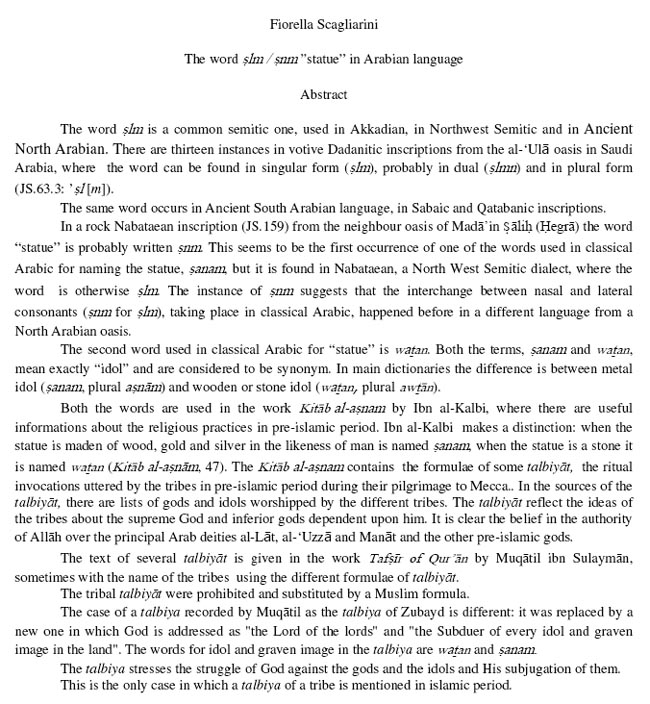
The word slm/snm 'statue' in Arabian languages. Fiorella SCAGLIARINI (
University La Sapienza
, Italy).
Biography:
Dr. Fiorella Scagliarini has a Degree in Oriental History: Hebrew and a Doctorate in Semitic Linguistics.
Abstract:
SESSION VI: Ancient South Arabia (chair: Nadia DURRANI, Current World Archaeology, UK)
14:00 W F Prideaux (1840-1914); Britain's first Sabaeologist? Carl PHILLIPS (ArScAn du CNRS, Paris, France) &
St J. SIMPSON
(The
British Museum
, London, UK).
Biographies:
Phillips, Carl
UMR 7041, ArScAn du CNRS, Maison René Ginouvès de l'Archéologie et de l'Ethnologie, France
Carl Phillips studied prehistory at Edinburgh University. He has worked on archaeological projects in most countries of the Near East and particularly in the countries of the Arabian Peninsula. He is currently engaged on projects in the United Arab Emirates and Yemen. Between 1990 and 2000 he taught at the Institute of Archaeology (London) and is currently a researcher with CNRS UMR 7041 (Paris).
Simpson, St John
Department of the Ancient Near East, The British Museum, London.
St John Simpson is an archaeologist and the curator responsible for the pre-Islamic Arabia and Iran collections in the British Museum. He is currently preparing new gallery displays of these collections which re-open in early 2007.
Abstract:
Educated in UK - joined Indian Army - posted to Aden and then Magdala. After that was assistant resident in Aden where he became interested in South Arabian inscriptions, and played a major role in the development of the relevant collections in the British Museum between 1871 and 1877. He was subsequently posted to Zanzibar and then Bushehr, where he reported on other archaeological opportunities but was disappointed not to become Consul-General in Baghdad as he had hoped to excavate in Mesopotamia. He spent the remainder of his career in India and during this time he published a number of articles on South Arabian inscriptions and numismatics which include the first Sabaean Grammar published in English (1877). He returned to England toward the end of the 19th century and pursued an interest in literature and folklore. He communicated more that 1000 pieces to the journal "Notes and Queries" and also published bibliographies of Fitzgerald, Coleridge and Stevenson. This paper will illustrate the career of this important early scholar with objects presented by him to the British Museum and include the contents of previously unpublished correspondence.
14:25 From Safîr to Balhâf - Preventive archaeological survey and rescue excavations along the Yemen LNG pipeline route (Governorates of Marib & Shabwa, Yemen). Rémy CRASSARD ( CEFAS , Yemen) & Holger HITGEN ( DAI, Yemen ).
Biographies:
Crassard, Rémy
Centre Français d'Archéologie et de Sciences Sociales de Sanaa (CEFAS), Sana'a, Yemen
Mr. Rémy Crassard is a PhD candidate at Paris I University Panthéon-Sorbonne. He is a permanent researcher at the French Centre for Archaeology and Social Sciences in Sana'a (CEFAS, Yemen). His main interest is the prehistoric period (Palaeolithic and Neolithic) in the Arabian Peninsula. He is finishing a PhD on the Prehistory of Yemen.
Hitgen, Holger
Deutsches Archäologisches Institut, Sana'a, Yemen
Mr. Holger Hitgen is a researcher and consultant in South Arabian archaeology. He is a researcher at the German Archaeological Institute branch of Sana'a (DAI, Yemen). His main interest is the study of settlement patterns in Yemen, he works every year in numerous projects at Marib, Sirwah and on the Jabal al-'Awd.
Abstract:
The Centre Français d'Archéologie et de Sciences Sociales de Sanaa (CEFAS) and the Deutsches Archäologisches Institut (DAI) in Sana'a, in cooperation with the Yemeni General Organization of Antiquities and Museums (GOAM), carried out a preventive archaeological survey along the route of a projected pipeline that will transfer the natural gas from Safîr deposits (Governorate of Marib) to the future Yemen LNG facilities in the village of Balhâf (Governorate of Shabwa). This survey took place along the route in order to identify all archaeological sites in danger of partial or total destruction due to the future construction of the pipeline. Archaeological remains are from the most different time periods. These reach from the earliest prehistoric times to recent Islamic occupations. 171 archaeological sites have been individualized and documented by preliminary plan drawing, photographic covering and material sampling. The use of a Geographic Information System (GIS) permitted a precise localization of the archaeological occupations along the studied area. This paper will present the methodology used for the fieldwork and the nature of the discovered sites. A focus will be done on the first results of the excavations realized on two major sites: the ancient Hadramitic settlement of Darbas at the Wadi Jirdan (ca. 2nd half of the 1st millennium BC), unknown until now, and on a widespread sample of Bronze Age funerary structures on the western Jawl.
14:50
Rites and funerary practices at Rawk during the fourth millennium BC (Wadi 'Idim-Yemen).
.
Tara STEIMER-HERBET
(IFPO, Syria), A. AS-SAQQAF (Sayyun Museum), O. LAVIGNE (EHESS, France), T. SAGORY (EPHE, France), J.F. SALIEGE, M. MASHKOUR (CNRS, France), H. GUY (INRAP, France).
Biographies:
Steimer-Herbet, Tara
IFPO (French Institute for Middle East Research), Damascus, Syria.
Doctor in archaeology from Paris University (Paris I), Tara Steimer-Herbet has been a researcher for the French archaeological institute in Damascus (IFPO-Syria) since 2004. She has developed a research programme on pastoral's remains in south Levant and Arabia during the 3rd and the 4th millennium BC.
As-Saqqaf, A.
Directeur du Musée de Sayyun.
Mr. Abdull-Rahman Al-Sakkaf is the director of General Organisation of Antique and Museum in Seyun (Yemen)
Lavigne, Olivier
Tailleur de pierre, architecte, archéologue, historien des techniques, EHESS, Paris, France.
Olivier Lavigne is a specialist in dry stone architecture. Studied Egyptian archaeology at the Ecole Pratique des Hautes Etudes (EPHE, Sorbonne Paris). Working in Egypt for the French mission of Tanis and now in Yemen with the French mission.
Sagory, Thomas
Archéologue, photo cervoliste, céramologue, EPHE, Paris, France.
Archaeologist and kite aerial photographer. Thomas Sagory is working for the French Department of Culture on a collection of websites on archaeology. Studied Egyptian archaeology at the Ecole Pratique des Hautes Etudes (EPHE, Sorbonne Paris). Working in France for the INRAP, in Egypt, for the French mission of Tanis. More info at:
http://www.du-ciel.com
with the collaboration of
J.F. Saliege
(Ingénieur de recherche, CNRS, Paris),
M. Mashkour
(Chercheur, CNRS, Paris) and
H. Guy
(Archéologue, INRAP, Paris). Jean-François Saliège works for LOCEAN's Laboratory in Jussieu University (Paris). Marjan Mashkour is an archaeozoologist working for CNRS (Paris). Hervé Guy is an anthropologist, currently working for INRAP (Paris)
.
Abstract:
In November 2005, the French team conducted by T. Steimer-Herbet excavated a stone structure in the centre of Rawk's village, east side of Wadi 'Idim (Hadramawt). In spite that a major part of the site was destroyed by new cowshed and by sayla of sha'b Rawk, the villagers found in 1989 three anthropomorphic statues and one in 2004. A. as-Saqqaf, director of the Sayyun Museum with A. Sedov published an article on the first three statues. The discovery of the fourth one conducted the head of the Museum to propose to the French Jawf-Hadramawt mission to start an excavation. The shape of the structure still not very clear only 5 upright stones was preserved, but the function as a cultic place is now well attested. A fifth statue was found in situ and was associated with skulls of a woman and two child and a lot of fire places. C14 dates coming from JF. Saliège will give us chronological frame of the place. Five others anthropomorphic statues were found in Yemen ones of them by A. de Maigret, B. Vogt and D. Pickwoth but all of them were out of archaeological context. The excavation of Rawk will provide dates and new elements on religious believes as 'cultic ancestors' in Yemen.
15:45 Giving Zafar a New Face. Paul YULE , Kristina FRANKE & Cornelia RUPPERT (University of Heidelberg, Germany).
Biographies:
Yule, Paul
Semitic Studies, University of Heidelberg, Germany
Paul Yule's Arabian specialities include pre-Islamic metalwork, the bronze and iron ages, as well as cultural resource management. His most important publications deal with the late antique and early medieval Arabia. Since 1998 he has led the Heidelberg University - GOAM Expedition at Zafar.
Franke, Kristina
Semitic Studies, University of Heidelberg, Germany
Kristina A. Franke, M.A. studied Near Eastern Archaeology, Prehistory and Semitic Studies at the LMU Munich. In addition to participating on numerous excavations in Europe and in the Near East, she took part as the excavation leader on the University of Heidelberg Expedition to Zafar/Yemen in 2004 and 2006.
Ruppert, Cornelia
Semitic Studies, University of Heidelberg, Germany
Cornelia Ruppert is majoring in Semitic Studies at Heidelberg University. She took part in the field season in 2006 in Zafar where she studies the local dialect with special regard to the place-names. Her thesis deals with the character of the modern Zafari dialect and its remains of Himyarite (Old South Arabian language closely related to Sabaic) and Ge'ez (Classical Ethiopic).
Abstract:
Since 1998 seven seasons of survey-mapping, museum cataloguing and excavation in and around Zafar have revealed considerable information about the empire (c. 270-523 CE) and late period (523-630 CE) which is the temporal emphasis of our project. Previous published study is mostly philological, with the exception of M. Barceló's survey of the presumably fossil asdad and jirbat.
The 110 hectare mapped surface includes the city intra muros. Immediately to the south lie further Himyarite settlement which have yet to be investigated. Zafar is generally accessible from the west although small paths penetrate the highlands in other directions. The most typical find at Zafar is a relief-fragment - even more common than pottery shards. Large numbers of fragments have accumulated in the site museum since its founding in 1971. Several correspond in style, type and subject with those excavated on the western edge of the Husn Raydan. 14C determinations and stylistic comparisons with Roman works illuminate their chronology.
A main issue is the development of polytheism, Judaism and Christianity in the period under consideration. Excavation reveals grave goods to be in use into the sixth century CE, relevant in this question. A rock-cut chamber in area known as al-Jahw beneath the present-day mosque of pre-Islamic origin is relevant for the development of religious architecture.
This area contains the greatest concentration of Himyarite tombs. The reason may be sought in an attempt to inter as close to a cultic centre as possible.
Excavation has revealed a complex palatial in nature. The majority of the architecture may date to the empire period.
Annual preliminary reports are in the press.
16:10 New evidence of cultural changes at Makaynûn during the first millennium BC. Anne BENOIST (
CNRS, Lyons
, France), Michel MOUTON (CNRS-IFPO, Syria), Jérémie SCHIETTECATTE (Nanterre, France) & Olivier LAVIGNE.
Biographies:
Benoist, Anne
Archéorient, CNRS, Maison de l'Orient, Lyons, France
After 15 years of research about Iron Age in Eastern Arabia, Dr. A. Benoist is now also working in Yemen on the evolution of settlements and territories during the South-Arabian Period. Supervising the French Archaeological Mission in Jawf-Hadramawt she is conducting excavations on the South-Arabian site of Makaynûn, in eastern Hadramawt.
Mouton, Michel
CNRS-IFPO
, Damascus, Syria
Schiettecatte, Jérémie
Maison de l'Archéologie et de l'Ethnologie René Ginouvès, Nanterre, France
Jérémie Schiettecatte has recently defended his PhD in archaeology at the Sorbonne University in Paris, he is a grant holder of the ministry of Research in the French archaeological centre in Sana'a (CEFAS). He focuses on towns and the urbanisation of pre-islamic Yemen. He joined several French archaeological missions in Yemen (supervised by M. Mouton; Ch. Robin; A. Rougeulle; M. Arbach) and the Italian mission in Tamna, supervised by A. de Maigret.
Lavigne, Olivier
Abstract:
Since 2002, the French Archaeological Mission has been excavating the South-Arabian site of Makaynûn, in eastern Hadramawt. During the two first campaigns, a fortification wall had been unearthed around a central area comprising public and religious buildings. A sounding carried out in the southern part of this central area had revealed a sequence covering the main part of the first millennium BC, and made up of layers including fireplaces and postholes.
Researches conducted during the third campaign will be presented in this paper. The mapping of the southern part of the fortified area has been completed by surface clearings. For the first time, dwellings have been discovered in layers older than the fortification wall. The oldest one is dated from the end of the second millennium BC. Local traditions in architecture and techniques of construction seem to have abruptly changed during the first half of the first millennium BC. This change may coincide with the Sabaean expansion in this region of Hadramawt.
16:35 Statement from the Steering Committee
16:45 FILM - Wilfred Thesiger and the story of the hare. John DOLLAR (Volcano Films Ltd, UK).
Biography:
John Dollar studied geography at Bristol University, then worked for ten years for BBC TV before becoming an independent producer of TV documentaries for Channel Four and others. He has had a lot of experience in the Arab world and maintains a profound interest in its people and history.
Abstract:
Wilfred Thesiger and the story of the hare Short Film (running time 21mins)
Taking cues from the interviews (therefore not in strict chronological order) the film summarises the main biographical chapters in Thesiger's life, so that an uninformed audience may understand him. Much of this will be familiar, I would imagine, to those who attend your seminar. However, for those who never met him the film provides a glimpse of the great man's character. Even in his dotage he was surprisingly feisty (he damns the Americans at one point), yet a perfect gentleman. The moment that he recalled most vividly and frequently (from which the title springs) occurred during his Empty Quarter crossings, when the standards of his Bedu companions outmatched his own. His ultimate world view was bleak.
The film contains many of Thesiger's own photographs, others of him, and extracts from a film made for the BBC in 1967 called 'The Empty Quarter'. It has two short blanks in it at the moment -- shots of him at Eton and of his journals, and modern shots of automobilia in the Gulf. I shall shortly fill both of these.
17:15 END
18:00 Reception in Clore Centre, British Museum.
SATURDAY 29 JULY 2006
SESSION VII: Environment, Trade and Production in Medieval Arabia (chair: Derek KENNET, University of Durham, UK)
9.30 New inscriptions from Mahram Belqis. Plus a New Dated Zabur Inscription. - Yusuf ABDULLAH (AFSM, USA).
Biography:
None provided.
Abstract:
The paper is composed of two parts however, with logical sequence :1- New interesting Inscriptions from Mahram Belqis (Marib) AFSM campaign (2006). 2- A Unique Zabur Inscription from Damar University Museum, dated according to the Himyarite Calendar.
9:55 Ceramic production in medieval Yemen: the Yadhghat kiln site.
Axelle ROUGEULLE
(CNRS - UMR 8167, Paris, France).
Biography:
Axelle Rougeulle studied Arabic language and archaeology at Paris University. After working on several medieval sites in the Middle East she specialised in the history of Indian Ocean trade. She is currently director of the Yemen Southern Coast Study Project and of the excavations at the port site of Sharma.
Abstract:
While excavating the medieval harbour site of Sharma on the coast of Hadramaut, a survey in the hinterland led to the discovery of a contemporary ceramic production centre, the first site of this kind documented in Yemen.
Yadhghat is located 12km north of Sharma, in the Wadi Hamem. The site is partly destroyed except for a dozen buildings, but delivers several heaps of ceramic shards associated with surface areas made of a strong layer of ashes, charcoal and burnt clay pellets, obviously the places of open air pottery kilns.
Soundings in the heaps yielded fragments of jars, pots, bowls, and incense-burners in a typical coarse ware. Identical pieces were found in quantity at Sharma, together with other shapes in the same fabric; they were certainly produced in the vicinity, maybe at Jerba, 1km west, where surface shards of this kind were found although the site is now totally destroyed. Petrographic and Raman spectroscopic analyses of Yadhghat shards and samples of local clay are now in progress.
Both sites also delivered imported material typical of the Sharma horizon (ca 980-1140), Chinese porcelains, Iranian sgraffiatos, African and Indian pots, testifying of the strong inter-connexions between the foreign entrepot and the local hinterland. But the presence of Abbasid pieces suggests that the prosperity of the kilns started before the foundation of Sharma, probably due to commercial exchanges with the port of al-Shihr, 50km westwards, as Yadhghat pieces were also identified there. The end of the kilns seems to be connected with the end of Sharma, as the typical kegs of probable Egyptian origin which characterize the destruction layer of the port were also found at Yadhghat and Jerba.
10:20 Al-Jabali: a silver mine in the Arabian peninsula. Audrey PELI (Laboratoire Islam médiéval, Paris I Sorbonne University,
France) & Florian TÉREYGEOL (
CNRS
, France).
Biographies:
Peli, Audrey
UMR 8167 Orient et Méditerranée (Laboratoire Islam médiéval), Paris I Sorbonne University, Paris, France.
Audrey Peli is studying for a PhD in Islamic archaeology in the area of mines, metallic and coins production in the south of the Arabian peninsula between the 7th-12th centuries and she is also involved in the study of ceramics for the Jabali mission.
Téreygeol, Florian
UMR 5060, Institut de Recherche sur les Archéomatériaux (Orléans), Centre d'études atomiques, Laboratoire Pierre Süe (Saclay), France.
Florian Téreygeol has a doctorate in archaeology, is an archaeometallurgist researcher with the CNRS and chief of the Jabali mission (Yemen).
Abstract:
The Arabic geographical texts gave some information on the mines of gold, silver, copper and iron set in the Arabian peninsula.
Most of these mines are situated in the Hijaz, where gold was extracted in the time of the Abbasid, as Hester's archaeological surveys proved it. Two of these mines were also pilgrim station: this situation shows how important these mines were for the political power in term of gold production, as some coins record it, and in term of pacification of the region.
Yemen appeared to be the richest region according to the Yemenite al-Hamdani. In his Kitab al-Jawharatayn, he focuses on the mines of al-Radrad which has been identified with the modern site of al-Jabali. This site would have been exploited during pre-Islamic times and ceased after the assassination of the local ruler in 883 A.D.
The aim of this communication is to present the project held on this site, the 2006 survey mission and to reinsert al-Jabali in the context of mineral exploitation in the Arabian peninsula at the beginning of Islam. This project will bring together geological and archaeometallurgical approaches, ceramic study and translation of al-Hamdani's technological chapters.
10:45-11:15 Coffee
11:15 Recent Archaeological work at Al Balid, Oman. Juris ZARINS (Missouri State University, USA) & Lindsay DECARLO (University of Chicago).
Biographies:
Zarins, Juris
Department of Anthropology, Missouri State University, USA.
Juris Zarins, Ph.D. University of Chicago (1976). Archaeological fieldwork as a student and professor, 1967-2006. Research interests on pastoral nomadism in Arabia, Neolithic -Islamic Periods. Current research focuses on Indian Ocean littoral along the southern Arabian coast.
DeCarlo, Lindsay
University of Chicago, USA.
I am a Ph.D. candidate at the University of Chicago focusing on Islamic archaeology in Arabia and Iran. I have participated in the Madaba Plains Project in Jordan, and recently in the excavations conducted by Juris Zarins at al-Baleed last fall. In addition I have studied an assemblage of ceramics from al-Baleed collected during M. Jensen's campaigns (1995-2003) at the site.
Abstract:
Al Baleed, (ancient Zafar) located on the Salalah plain in the Sultanate of Oman, has been the subject of numerous archaeological activities since 1952. However, the Al Baleed Project, a five year excavation and survey program that began in 2005, will be the first to establish a secure chronology for the site, including evidence for Bronze and Iron Age occupations. The first season focused on two specific areas, including a mosque with at least two rebuilds and a substantial house complex. The deep sounding below the mosque revealed additional foundations, confirming an older occupation of the city. A detailed site survey helps amplify the Arabic historic record. For example, Ibn Battuta comments on the numerous mosques in the city. Over 50 mosques were located this last season alone. In addition, a limited survey reveals that the city spanned beyond what is currently delineated as the site. Survey in the eastern portion of the site suggests where goods vital to the local economy, including horses, frankincense and sardines, were probably kept and traded. Zafar's location on the Indian Ocean littoral positioned it to engage in not only maritime trade, but also to participate in an active interior trade linking it with eastern Arabia.
11:40 Al Qisha: Archaeological Investigations at an Islamic Period Yemeni Village. Lynne NEWTON (University of Minnesota, USA).
Biography:
Newton, Lynne
Anthropology Department, University of Minnesota, USA
Lynne Newton is a Ph.D. candidate in Anthropology at the University of Minnesota. Focusing on southern Arabia, her interests include ethnoarchaeology and ethnohistory, Islamic archaeology and pastoral nomadism. Lynne has conducted archaeological fieldwork in Oman and Yemen and is currently the co-director of the Al Baleed Project in Dhofar, Oman.
Abstract:
Al Qisha (9th Century AD-present), the only Islamic period non-port settlement site excavated in the Mahra Governate of Yemen to date, is located approximately 6 kilometers north of the Indian Ocean at the mouth of Wadi Masila, some 20 kilometers west of Sayhut. The site of Al Qisha spans over a kilometer and includes an extensive village (part of which is still inhabited), a cemetery and a mosque. Other research of the Islamic period in this region focuses on port sites, such as Hayrij, Sharma and Al Shihr. While such an approach facilitates understanding Arabia's maritime connections at this time, the Al Qisha excavations provide a unique opportunity to begin exploring local trade and habitation patterns. Therefore, using Al Qisha as a case study, this paper examines the previously poorly understood relationship between ports and the Hadhrami/Mahra hinterland. In addition, utilizing an ethnoarchaeological approach, research at Al Qisha provides insights on the complex historic relationships between settled and nomadic populations and their implications for understanding the archaeological record through time and space.
12:05 Vegetation History and Wood exploitation at Kush, Ras Al-Khaimah, UAE: Results of the charcoal analysis. (University of Paris I, France).
Biography:
Tengberg, Margareta
UMR 7041 - Archéologies et Sciences de l'Antiquité, Université de Paris I -Sorbonne, France
Dr Margareta Tengberg is a lecturer in Archaeobotany at the University of Paris I-Sorbonne. Her research, based on the analysis of botanical macro-remains (wood, seeds ), aims at understanding interactions between human societies and the plant world in the ancient Middle East. She is at present involved in projects in eastern Arabia, Iran and Turkmenistan.
Abstract:
The excavation of Kush in the Emirate of Ras al-Khaimah included since its very beginning extensive and planned sampling for bioarchaeological remains. Numerous charcoal fragments, mostly resulting from the cleaning out of domestic hearths and ovens, were retrieved by flotation. The identification of more than twenty taxa has allowed the reconstruction of the vegetation cover around the site from Sasanian times until the 17th/18th century AD. Three different ecosystems were exploited for fuel by the inhabitants of Kush: coastal mangroves with grey and red mangrove trees, dry open thorn woodlands dominated by acacias and jujubas and wadi plant communities of the Hajar mountain range with, among others, wild fig and almond. These vegetation communities underwent certain changes through time with the regression and even the disappearance of particular species, probably due to the overexploitation of wood resources.
12:30 Water and waste in medieval Zabid, Yemen. Ingrid HEHMEYER (Ryerson University, Canada).
Biography:
Hehmeyer, Ingrid
Department of History, Ryerson University, Canada
Ingrid Hehmeyer is an Assistant Professor for the History of Science and Technology at Ryerson University, Toronto. She specialises in human-environmental relationships in the arid regions of ancient and mediaeval Arabia. Her current fieldwork in Yemen focuses on questions of technical innovations in hydraulic engineering and strategies for water management.
Abstract:
Engineering standards and technological traits are reasonably well documented for urban water supply systems both in the classical world and in medieval Europe. Systematic investigation of these topics is only just beginning for the medieval Islamic city. While engineering schemes may be mentioned in general in the historical texts, descriptions of the technical or functional details are normally lacking in the written sources. This paper presents tangible evidence of urban water delivery and waste management which is derived from archaeological excavations in the city of Zabid, during the December 2005 - January 2006 field season of the Royal Ontario Museum Yemen Project. The features exposed include wells, water-storage tanks, open surface channels, covered conduits, lead water pipes, public bathing facilities and toilets. Based on the archaeological context they can be dated to the 13th to 16th centuries. While the technical details provide information on the engineering skills of the builders, these features more importantly reflect upon the standards of water and waste management services that were available for ordinary people in Zabid, and thus upon the quality of life in the medieval Islamic city.
12:55-14.00 Lunch
SESSION VIII: Domestic and Religious Architecture, Ethnography and Islamic History (chair: Venetia Porter, The British Museum, UK)
14:00 Towards a new perspective: Banu Mahdi, a 4th imamate in Yemen. Ahmad O AL-ZAYLAI ( Department of Archaeology, King Saud University , Arabia).
Biography:
Professor Dr Ahmad Omar Al-Zaylai is a Saudi National and Professor of Islamic archaeology at King Saud University. His specialization is Islamic Epigraphy and he has many publications on Arabian Islamic archaeology and history.
Abstract:
The view currently held by historians is that the Yemeni rulers of Banu Mahdi state who ruled from 554 to 569 AD /1159 - 1174 AD with their capital at Zabid, were of khwarij faith. This paper presents a different view and addresses a new perspective which states that Banu Mahdi rulers were not of khawarij faith and they did not consider Ali Bin Abi Talib as infidel. On the contrary, Banu Mahdi's rare coins clearly indicate that they recognized Ali's imamate and his holy rule. In addition, this paper displays that Banu Mahdi raised their ruling system to imamate rank and they did not recognize other such custodianships that prevailed in Yemen as Abbasid or Fatimid or even Zaydiya imamate. They recognized themselves as imams and each bore the title of imam. While some entitled themselves as al-Mahdis, others held the title of 'Shams shariat al-Islam'. To my knowledge, this latter title was noted for the first time on the very rare Islamic coins attributed to the ruler Abdu'l Nabi Bin Mahdi.
14:25 Traditional Houses in Saudi Arabia: Similar Principals and Different Forms. Mashary AL-NAIM ( King Faisal University , Saudi Arabia).
Biography:
Al-Naim, Mashary
College of Architecture and Planning, King Faisal University, Kingdom of Saudi Arabia
Mashary Al-Naim is associate professor of architectural criticism in the faculty of architecture at King Faisal University, Saudi Arabia. He is also the senior editor of Albenaa magazine (professional architectural magazine). As an architect he designed and refereed several projects in Saudi Arabia, Gulf region and Arab world including Arab city award, Sultan Qabos Award and Kind Abdulla Award. Al-Naim worked as consultant for governmental and private for large-scale construction projects. His research and writing spanned cultural impact on architecture, education and professional practice. He has weekly column in AlRiyadh Newspaper since 1996 and monthly column in several journals.
Abstract:
In Saudi Arabia there are many typological houses spread over a vast area. Traditional houses developed over centuries and took their forms from a deep interaction with local culture and technology. However, there were shared principles mainly generated from the Islam and local Arab values in the Arabian Peninsula. In fact, local people, in various regions, have interpreted these principles differently. The process that took place has generated different types of traditional houses. This paper tries to understand how and why traditional houses took their forms and investigate to the extent that main shared principles (Such as privacy, hospitality,) where reflected in different ways in the physical environments by local people in the different region of Saudi Arabia. For the purpose of the study a comparison between four regions including Al-Hassa, Najd, Hedjaz and Asir were adopted. And the comparison conducted in three levels including communities, neighbourhoods and houses.
14:50 Star Gazing in Traditional Water Management: a case study in Northern Oman. Harriet NASH ( University of Leeds , Leeds, UK).
Biography:
Harriet Nash: BSc Geography and Geology (QMC, University of London, 1972); MSc hydrogeology (University College, University of London, 1977). Harriet is a hydrogeologist who formerly specialised in assessing water resources and community water supplies in arid countries. She has worked in this capacity in Oman, in the early 1970s and again in 1985 and 1986. She is an active member of the International Association of Hydrogeologists and of the Register of Engineers for Disaster Relief. Currently she is a PhD student at the Department of Arabic and Middle Eastern Studies at the University of Leeds. She studied Arabic at Leeds in the early 1990s with Professor Dionisius Agius, who is her supervisor. Her research in Oman focuses on the cultural aspects of water management and aims to record a dying art - the use of stars for timing the allocation of irrigation water.
Abstract:
The paper will present the results to date of my field research into the use of stars for timing the allocation of water in traditional irrigation systems in Oman. Since antiquity the stars and the sun have been used in Oman to define the passage of time in order to allocate water for agriculture, which is vital to settled life in the region. As the dependence on agriculture decreases, traditional methods of water management, and particularly the use of stars, are vanishing. Some Arabic star names are well known, especially those used in Islamic lunar calendars. However, in Oman, many of the stars used for time telling are known only by their local name. The research has enabled me to identify the majority of these stars using their international designation, and this information will be presented for the first time. The methods used to divide time by the stars into irrigation units differ from place to place, and the main methods observed during the research will be described. The paper provides new information for anyone interested in cultural aspects of agricultural settlements in Oman.
15:15-15:45 Tea
15:45 The Anthropology of 'Modernity' in Soqotra: Exploring the Vectors of Change in a Transitional Community. Serge D. ELIE ( University of Sussex , UK)
Biography:
Elie, Serge D.
Department of Social Anthropology, University of Sussex, UK.
He is a D.Phil candidate in social anthropology, and is completing a dissertation on Soqotra entitled 'The Waning of a Pastoralist Community'. He is a former international development professional at the UN. His research interest is in the interface of history and anthropology in the study of societal change.
Abstract:
The Soqotra Archipelago is Yemen's ultimate frontier, straddling the African Continent and the Arabian Peninsula. Its approximately 50,000 inhabitants, who occupy a hyphenated geographical place as well as an interstitial cultural space, are caught between a fading past and an uncertain future. As Soqotra, the main island of the Archipelago, is undergoing an accelerated change process driven by a dual incorporation process: on the one hand, the Yemeni government's modernization of its infrastructure and consolidation of its political incorporation into the national community; and, on the other, a United Nations led internationalization of its economy through the implementation of an environmental protection and ecotourism development programme.
Based on eighteen months of fieldwork in Soqotra, and using a 'processual ethnography' approach, the paper seeks to show the gradual, yet inexorable, transformation process of what was a predominantly pastoralist community with a unique language and a mixed ethnic composition through the following steps: First, it situates the island's transformation process through an historical overview of the four phases of its political encompassment (i.e., sultanate, socialist administration, unity government, and post-unity regime), which introduced four divergent types of administrative regimes (i.e., benevolent absolutism, democratic centralism, tribal libertarianism, and an internationally-mediated local governance). Second, it identifies the vectors of change in the form of critical processes (i.e., communal mutation, national acculturation, and transcultural annexation) generated by the last phase of political encompassment, and explores their consequences in terms of culture, economy, politics, and environment. Third, it considers the cultural and developmental dilemmas generated by this process of change.
16:10 Rare photographs from the 1930s and 1940s by Yihyeh Haybi, a Yemenite Jew from Sanaa : Historical Reality and Ethnographic Deductions. Ester MUCHAWSKY-SCHNAPPER ( The Israel Museum , Israel).
Biography:
Muchawsky-Schnapper, Ester
Department of Jewish Ethnography, The Israel Museum, Jerusalem, Israel
As curator in the Department of Jewish Ethnography in the Israel Museum I have been researching the museum's important collection of Yemenite objects, resulting in the publication of articles and a major exhibition and catalogue. The material and stylistic object-analysis has been complemented by fieldwork with Yemenite immigrants in Israel.
Abstract:
A collection of 300 photographs taken by the late Yihieh Haybi in Yemen in the 1930s and 1940s, together with his photographic equipment, are part of the Israel Museum's ethnographic holdings. An analysis of these photographs and interviews with the photographer's widow and other contemporaries helped to piece together a rich cultural kaleidoscope of Yemen, mainly Sana'a, in this crucial period of its history, before it started undergoing modernization.
Yihieh Haybi, a unique local photographer in Yemen at the time, photographed mainly his own Jewish community, offering us precious insights into their modes of dress and habitation, but allowing also socio-psychological deductions based upon behaviour and facial expressions. By comparing the photographs with information drawn from interviews and object analysis, a more complete cultural picture could be gained. It also became apparent that some of the photos were what we would call today 'staged' which teaches us not to accept photographic documentation without the support of additional research.
Haybi who also photographed royal members of the court, Muslim notables and street scenes, even succeeded in catching rare historical moments such as public beheadings. His legacy is today of invaluable importance.
16:35 Closing remarks and END.
POSTER PRESENTATION:
Aufnahme archaeologischer Befunde in Zafar/Dhu Raydan (Jemen)
N. CARSTENSEN
In the seventh season of mapping in 2005, surveyors from the Institute for Spatial Information and Surveying Technology, University of Applied Sciences in Mainz, took to the field. The main task was to map the mountainous western edge of the site, an area measuring some 1200 x 200m. This surveying revealed a
number of sites presumably of the Himyarite empire (c. 260-523) and late periods (523-c. 570) and filled out the mapping frame. It also enabled the rectification of the Quickbird satellite imagery. The survey instrument which
we used functions without a reflector, a prerequisite for measuring inside of caves and tombs.
POSTER PRESENTATION:
Developing a framework of Holocene climatic change and landscape archaeology for the lower Gulf region, south-eastern Arabia.
Gareth W. PRESTON (Department of Geography, Oxford Brookes University, UK)
Gareth Preston is a second year PhD student and is undertaking high-resolution analyses from lake sediments in the UAE using multiproxy analyses e.g. geochemistry (ICP-AES, ICP MS), environmental magnetics, phytoliths, 14C and OSL chronologies. From this a detailed record of climate change is being constructed against which the archaeology of the region can be set.
Adrian G. PARKER (Department of Geography, Oxford Brookes University, UK)
Dr. Adrian Parker is head of Geography at Oxford Brookes University and specialises in palaeoclimatology, geoarchaeology and environmental reconstruction. Adrian has worked in southeastern Arabia for ten years and is interested in climate-society relationships using multi-disciplinary approaches.
Helen WALKINGTON (Department of Geography, Oxford Brookes University, UK)
Dr. Helen Walkington (sedimentology, pedology, geoarchaeology). Helen studies the physical properties of archaeological soils (including palaeosols) and sediments through particle size analysis and micromorphology. Thin sections are made from impregnated stabilised soil blocks for detailed analysis under the microscope.
Martin J. HODSON (School of Life Sciences, Oxford Brookes University, UK)
Dr. Martin Hodson is a plant physiologist and soils specialist. He is interested in phytoliths and their application to environmental archaeology and environmental reconstruction.
Abstract:
The coastal desert of the eastern Arabian Gulf has been an important focal point for human settlement since at least 8000 cal BP and consequently has a rich archaeological record. Despite some uncertainties the chronological and material sequence is now fairly well established for most of the archaeological periods. In contrast the nature of Holocene climate change in the Gulf region remains largely unknown. This uncertainty is the result of both spatial and temporal inadequacies in palaeoclimatic data currently available. To date only two high-resolution, terrestrial climate records have been reported for the entire Arabian Peninsula. These inadequacies mean a large gap remains in our knowledge as to how human activity in this region has been influenced by changes in climate, hydrology and vegetation during the Holocene. This is particularly significant given that climate-society studies elsewhere suggest that early human civilisations were extremely vulnerable to changing climatic conditions. This study hopes to address some of these problems by developing a high resolution record of Holocene climate variation against which the archaeology of southeastern Arabia can be set.
POSTER PRESENTATION:
Anwendungsmoeglichkeiten von Quickbird-Daten fuer ein Archaeologieprojekt
C. RUSCH
By means of distributing points over the entire survey area (1000 x 1200m), in 2005 we rectified the panchromatic and multispectral Quickbird images of Zafar. The resulting platform enabled computer orthographic photos and animated representations with and without the underlying survey drawings. The evaluation of the multispectral images enabled a classification of the landscape. In addition, new developments enabled the transfer of colour into the high-resolution black and white satellite images.
POSTER PRESENTATION:
Middle Palaeolithic - or what? A new site in Sharjah, UAE
Julie SCOTT-JACKSON (PADMAC Unit, University of Oxford, Oxford, UK)
Dr. Julie Scott-Jackson, Director of the PADMAC Unit (Unit for the study of Lower and Middle Palaeolithic artefacts from deposits mapped as Clay-with-flints), University of Oxford (
http://users.ox.ac.uk/~padmac/
), specialises in the geomorphology, geology and sedimentology high-level sights on deposits mapped as Clay-with-flints and the associated Palaeolithic artefacts. More recently she has extended her investigations to sites presenting similar problems in the UAE.
William SCOTT-JACKSON (PADMAC Unit, University of Oxford, Oxford, UK)
Dr William Scott-Jackson is the PADMAC Unit's landscape archaeologist and spatial analyst, applying Geographic Information Systems techniques to investigate the use of the landscape by early humans. He also carries out geophysical and spatial predictive modelling to identify potential Palaeolithic sites.
Sabah JASIM (Director of Antiquities, Sharjah, UAE)
Dr Sabah Jasim is Director of Antiquities, Sharjah, UAE and also oversees the various archaeological project teams working in Sharjah Emirate. (
http://www.archaeology.gov.ae/index_en.html
)
Abstract:
A 'Southern' route out of Africa to the Far East has been suggested by several authors (e.g. Forster and Matsumura, 2005; Petraglia and Alshareck, 2003). The United Arab Emirates (UAE) lie directly on this route and yet, to date, no Middle Palaeolithic sites have been identified. Rare individual finds from locations in the UAE have been variously described as Lower or Middle Palaeolithic but in the absence of firm dating evidence or associated debitage they have not been considered as reliable indicators of a Lower/Middle Palaeolithic presence. Dr Sabah Jasim, Director of Antiquities, has encouraged investigations of the early pre-history of Emirate of Sharjah. Following a desk based assessment of the region (and discussion with Dr Jasim and Prof. Hans-Peter Uerpmann of the University of Tubingen), Dr Julie Scott-Jackson and Dr William Scott-Jackson, of the PADMAC Unit, University of Oxford, investigated an area which had potential to yield a Palaeolithic site. These investigations resulted in the discovery of a prolific prehistoric stone-tool manufacturing site, situated at a high-level (~260m above sea level) overlooking a wadi - a similar geographic context to the locations of Palaeolithic sites in both Oman and the Kingdom of Saudi Arabia. Examination of selected artefacts from this site by various lithics experts has proved tantalising - as the artefacts suggest a Middle Palaeolithic affinity. The format of the poster will include maps, photographs of the artefacts and spatial details. It is hoped that this display will generate discussion and debate which will contribute to our understanding of the artefacts and ideas for further investigations of this site.
Forster, P. & Matsumura, S. 2005. 'Did Early Humans Go North or South?', Science 308: 965-966
Petraglia, M.D. & Alsharekh, A. 2003. 'The Middle Palaeolithic of Arabia: Implications for modern human origins, behaviour and dispersals', Antiquity 77: 671-684
POSTER PRESENTATION:
The Sources on the Fitna of Mas'ud b. 'Amr and Their Uses for Basran Tribal History
Brian ULRICH
Department of History, University of Wisconsin, Madison, USA.
Biography:
Brian Ulrich is a Ph.D. Candidate in history at the University of Wisconsin - Madison whose dissertation has the working title 'The Azd in the Early Islamic Centuries'. He has taught courses at both the University of Wisconsin and Beloit College (also in Wisconsin) and will spend 2006-07 as a research fellow at Hebrew University in Jerusalem. In addition to early Arab tribal history, his research interests include religious minorities in the Muslim Middle East and medieval trade routes. He also blogs primarily about Middle Eastern affairs as a contributor to American Footprints (
http://www.americanfootprints.com
) and at a personal site (
http://bjulrich.blogspot.com
).
Abstract:
After the death of Yazid b. Mu'awiyah, strife broke out in Basra resulting in the death of Mas'ud b. 'Amr, the leader of the Azd, and the payment by the Tamim of a significant amount of blood money. The sources as preserved in later chronicles, however, are confused on such important points as what Mas'ud's agenda was when he died, who killed him, and the details of what happened afterward. This poster will illustrate the main threads of these sources, as well as lay out the manner in which they may be used as for the history of Basra's Arab tribes.
POSTER PRESENTATION:
Perforators, scrapers and more from the lithic industry of Wadi Shab, a Middle Holocene site on the Oman coast
Donatella USAI
(
IsIAO
, Roma, Italy)
and A. CAVALLARI
Biographies:
Donatella Usai has a PhD in African Prehistory and is a lithics specialist. Her main research interest is the process of neolithisation of prehistoric societies with a focus on the Nile valley and Arabian Peninsula. She collaborates with the British Museum's Department of Ancient Egypt and Sudan, as a specialist in Late Paleolithic, Mesolithic and Neolithic lithic industries of the Nile Valley. Since 2000 she has been the director of an IsIAO (Rome) project in Sudan investigating the Mesolithic Ceramic sites of the VIII millennium BC and was a director with the Joint Hadd Project of M. Tosi and S. Cleuziou on the excavation of the Neolithic/Bronze Age site of Wadi Shab-GAS1, in Oman.
Agnese Cavallari is a graduate of archaeology at the University of Ravenna. Her thesis was on the Middle Holocene prehistory of Oman with a particular emphasis on the Wadi Shab-GAS1 site. She is now a freelance archaeologist operating mainly in Italy. She also collaborates as a lithic analyst for an Italian Project working at a Neolithic site on the Tunisian coast.
Abstract:
Our knowledge of Early and Middle Holocene lithic industries of Arabian Peninsula is growing with the numerous archaeological activities going on in these countries. Nevertheless we have to lament that, apart from few papers which became fundamental for any prehistorian working on the subject (Uerpmann 1992), detailed publications are rare.
Based on the assumption that making data available will develop the possibilities of building theories, interpretations, chronological frameworks this poster aim at offering a full description of the lithic assemblage of Wadi Shab-GAS1, a Neolithic-Early Bronze Age site located on the Oman Coast. The site, excavated in this last five years, has provided an interesting sequence starting from the IV millennium BC till the beginning of the III millennium BC. It is an opportunity to assess differences and elements of continuity which characterise this production and see how/if these differences can be grasped to more or less important change to which the people living at this site may have been subject.
The Wadi Shab-GAS1 lithic assemblage is basically oriented on a flake production that was directed to realise a quite differentiate range of tools that can finally be linked to activities witnessed by the relatively meagre cultural material produced in the archaeological excavation.
POSTER PRESENTATION:
The Latest Discoveries of the Mahram Bilqis Archaeological Project
Zaydoon ZAID (American Foundation for the Study of Man, Virginia, USA)
Biography:
Dr-Ing. Zaydoon Zaid has a Masters degree in Archaeology and a PhD from the Departments of History of Architecture at the Technical University of Aachen, Germany. (1997). He has been involved in the archaeology of Jordan and Yemen since 1986. In 2005 Dr. Zaid Joined the AFSM as an Architect/Archaeologist and worked at the Mahram Bilqis Archaeological Project in Marib, Yemen.
Abstract:
The Awam temple is one of the most significant architectural complexes in ancient South Arabia. The architectural complex components present a high quality of style and techniques. Architecturally, the Awam can be divided into different architectural phases, based on both architectural styles as well as archaeological and epigraphical data.
Previous work at the Mahram Bilqis included the 1951-52 AFSM expedition led by Wendell Phillips, and the renewal of work in 1998 to the present under the direction of Merilyn Philips Hodgson. These efforts concentrated on the Peristyle Hall (l951-52) and probes/soundings along the Oval wall (l998-2001). More detailed work to the northwest began in 2001 uncovering the complex now labeled Area A and continued until 2005 under A. Ghaleb. The sand-filled Peristyle Hall was re-excavated in 2002-2004. In 2004, the Northwest Gate was also re-excavated and the plan corrected. In 2005, an initial effort was made by M. Ibrahim to examine the oval interior to determine flooring, bedrock and the nature of the occupation within the Oval.
This Poster will present the results of the 2006 excavation efforts which focused on three areas; the Annex, Awam Oval wall west and Awam Oval wall east.
© Seminar for Arabian Studies 2006.
Website design by
markbeech.com
Go to
Top

About us
Committee
Contact
(MS Word - 108 Kb)
Index PSAS vols.1-34
Links
Proceedings
Seminar 2002
Seminar 2003
Seminar 2004
Seminar 2005
Seminar 2006
Seminar 2007
What's new?
email SAS
page last updated:
21 July 2006